

Back to Authors
Liu Ka-Shiang
劉克襄

Liu Ka-Shiang, is a writer of boundless creative energy and tirelessly explores new subjects and experiments with various literary forms, refusing to be confined to any single niche. He is widely regarded as a pioneering figure in contemporary Taiwanese nature writing. His works 11-Dollar Railway Journey and Fifteen Little Planets both won the Openbook Award and the Golden Tripod Award in 2 consecutive years.


In the 1990s, Liu published works centered on water birds and whales, including The Wind Bird Pinocha and The Humpback Whale Helian Momo. The Wind Bird Pinocha was hailed as Taiwan's first animal novel and selected as the Best 10 Books of the Year by China Times. Following this, he continued creating Taiwanese animal novels, publishing Wild Dog Hill and Albatross Forever. Albatross Forever won the Grand Prize for Fiction at the Taipei International Book Exhibition.


With each animal novel, Liu strives to experiment with new narrative forms, exploring nature and contemplating the relationship between humans and the natural world. These works also chart the evolution of a nature observer. In 2011, inspired by his children, he decided to revise his earlier work Lentil Forest, creating new color illustrations and republishing it as The Legumin Chronicles. Utilizing a fictional creature, this book represents the author's ambitious attempt to expand the scope of animal fiction.

Works
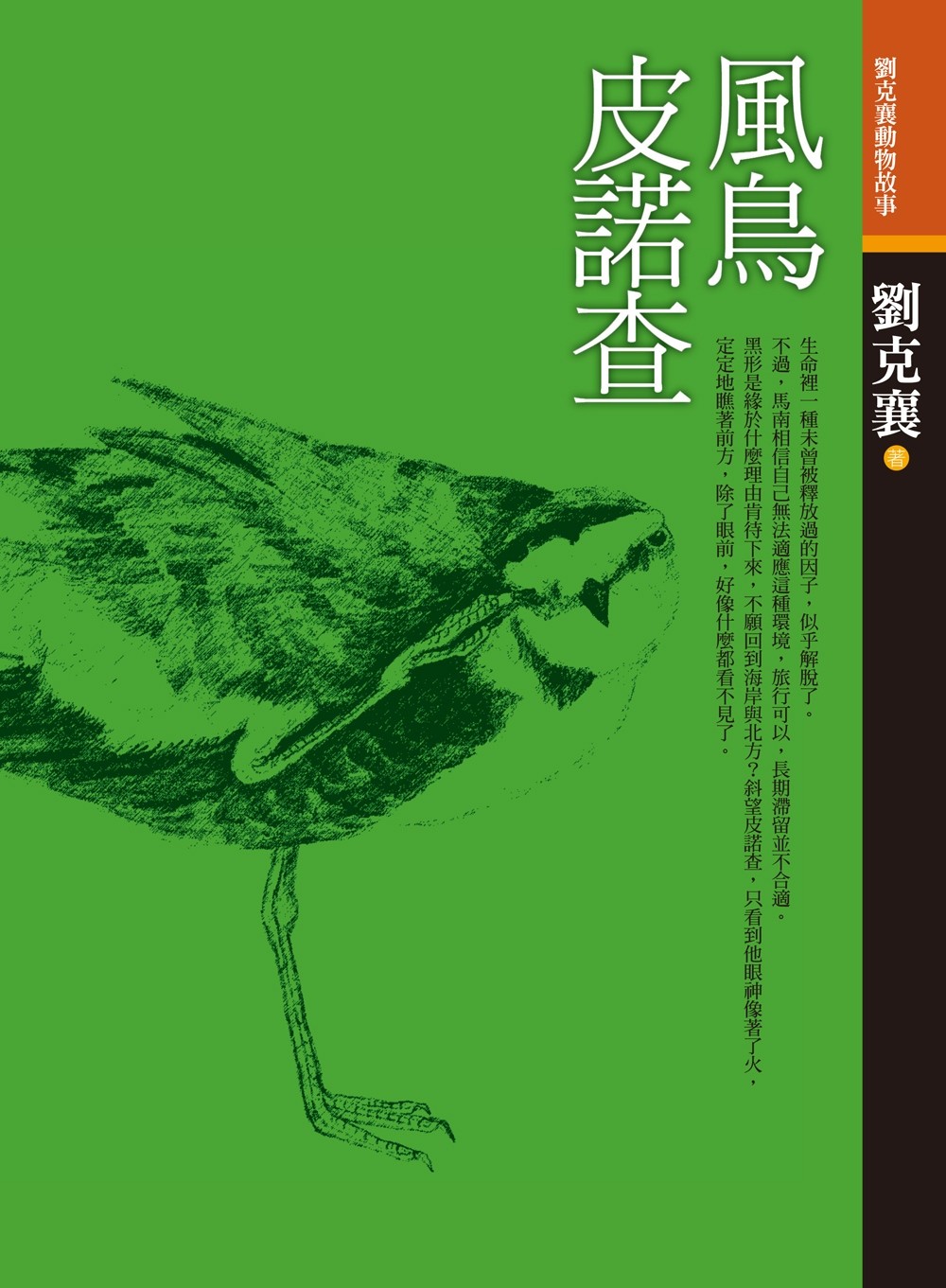
As Taiwan’s first landmark animal novel, this epic follows a lone waterbird on a perilous transcontinental migration, where he must navigate the brutal laws of nature to discover the true meaning of survival.   As the harsh northern winter approaches, Pinocha sets off on a southbound migration spanning thousands of kilometers. This journey is not merely an escape from the cold—it is a rite of survival. He flies across raging seas and treacherous wilderness. He witnesses companions fall to predators and confronts the despair of utter exhaustion. At last, he arrives at a vibrant southern island—Taiwan. Along Taiwan’s coastline, Pinocha embarks on a quest to find the “mysterious bird”—a legendary creature rarely seen and believed to embody the ultimate freedom and mystery of the natural world.    In Taiwan, Pinocha encounters a group regarded as outcasts within his species (Kentish Plover): resident birds who have chosen not to return north, instead staying in the south to breed. In the traditional worldview of migratory birds, refusing to return north signifies weakness and betrayal of lineage. Yet through his interactions with the resident birds’ leader, Pinocha begins to question this belief: Is perpetual migration truly the only meaning of life? Could putting down roots in unfamiliar land and facing local hardships also be an act of courage? Comp titles:  Watership Down by Richard Adams  H is for Hawk by Helen Macdonald   First published in 1991
Only the stars of childhood know where I have been.   Helian Momo is a humpback whale born with a unique spirit. Awkward within the pod and repeatedly failing at what other whales do naturally, he grows detached from the world around him. White Fang, another whale who was rival and enemy at first and turns to his only friend later. White Fang is fierce and impulsive, driven by raw courage and instinct, while Momo is introspective, inward looking, and quietly disillusioned with the world around him.    After a perilous adventure and parting in the river-mouth marsh, the two friends meet again years later, only to discover that time has led them to profoundly different understandings of life’s meaning. Now aged and weary, Helian Momo determines to honor his bond with White Fang, choosing to venture once more into the marsh and confront the death, even at the cost of his own life.   There, his solitary journey is interrupted by an unsuspecting grandfather and grandchild who stumble upon the stranded whale. Unaware of Helian Momo’s quiet resolve and tragic purpose, they are determined to save him and return him to the sea...   Through Helian Momo’s eyes, readers encounter both the majesty and the danger of the deep blue world: the haunting beauty of whale songs, the intricate social bonds within the pod, and the growing threats posed by climate change and human interference. It is a lyrical exploration of “oceanic consciousness,” a meditation on life, memory, and coexistence.
Three Legumins traverse a deadly wasteland to find help for their dying forest, only to discover their arrival upon a forgotten society ignites a power struggle that threatens both civilizations.   When the Great Forest falls into crisis from overpopulation and dwindling resources, the elders dispatch two exploration teams across the wasteland to seek salvation. Three surviving Legumins—Chu-Tzu, Hung-Mao, and Lu-Pi—brave deadly attacks and narrowly escape annihilation multiple times before finally reaching Rice Valley. It is inhabited by the Highland Legumins, a society of the same species, with whom the Great Forest has lost contact a century ago.   While Forest Legumins depleted their resources, Highland Legumins mastered resource management and invented weapons to combat predators. Thrilled by promises of support for the Great Forest, the three Forest travelers opened conversations once again between the Great Forest and Rice Valley. But their arrival unexpectedly catalyzes a power struggle among the Highland Legumins, pushing both themselves and the Great Forest toward an uncertain fate...   Originally crafted as bedtime stories for his two young sons, Liu Ka-Shiang's Chinese history inspired tale of the Legumin adventures, battles, and struggles became a cherished family tradition, showcasing Liu’s authenticity, indifference to power, and his reflections on nature. Originally published as part of a triology, Liu Ka-Shiang revised and rewrote the first book into The Legumin Chronicles, which serves perfectly as a standalone as well.
Back To TopBack To Top